Följande innehåll kommer användas i webbturen
Rubrik (Denna text visas över "Läs mer" texten samt över alla samlade verk i samlingen):
Nationalmuseum's latest acquisitions
Text (Denna text kommer visas under rubriken för webbturen):
Nationalmuseum's collections are under constant development and are continuously being expanded with new acquisitions. Here we highlight some of the most interesting additions made in recent months. Nationalmuseum receives no state funding for art acquisitions; rather, the collections benefit from donations and funding from private trusts and foundations. Thanks to these generous contributions, the collections can continue to grow.
Text för fler Samlingar (Detta är locktexten för fler webbturer som visas längst ned på sidan):
Click the link below to view a larger selection of new acquisitions from previous years
Objektlista

Artist: Louis-Jean-François Lagrenée d.ä.
Title: Self-portrait
Description:
January 2019 - Two 18th century portrait drawings
Nationalmuseum has acquired two 18th century portrait drawings. One is a self-portrait of Louis-Jean-François Lagrenée, while the other, by Johann-Ernst Heinsius, depicts an unknown woman. Both works are fully elaborated and demonstrate a technical virtuosity which captures both the personality and vitality of their subjects.
Louis-Jean-François Lagrenée (1725–1805) studied under Carle van Loo (1705–1765) in Paris in the late 1740s. In 1749 he won the Royal French Academy of Art's travel scholarship for studies in Rome, and in the course of the ensuing years spent in Italy he was influenced by Guido Reni (1575–1642) and Francesco Albani (1578–1660), among others. For a period at the beginning of the 1760s, he was Court Painter in Saint Petersburg and also served as the Director of the Imperial Academy of Arts. Much later, between 1781 and 1787, Lagrenée returned to Rome as the Director of the French Academy of Fine Arts.
Lagrenée specialized in mythological motifs characterized by a relatively austere classicism, but also created a smaller number of captivating portraits. The latter include a celebrated self-portrait, now housed in the collections of the Sinebrychoff Art Museum in Helsinki. In the profile portrait drawing recently acquired by Nationalmuseum, Lagrenée seems to depict himself with a certain amount of objectivity – a distance from his own personality and role as an artist. Despite his supposedly young years, he appears both urbane and somewhat sophisticated. This impression may also be amplified by the artist’s technique. While the profile is drawn with distinct contours, in the lines of the work as a whole the artist demonstrates a certain lightness of touch. This is a typical feature of the skilful draughtsmanship that Lagrenée developed during his studies in Italy.
Like his brother Johann-Julius Heinsius (1740 – 1812), Johann-Ernst Heinsius (1731–1794) was active as a portrait painter at the princely court in Weimar. Later, Johann-Ernst also worked in Hamburg, where he was commissioned to execute portraits of members of the city's burghers. Nationalmuseum's portrait depicts a young, vibrant woman looking over her shoulder to her left (from the viewer's point of view she looks to the right, and this is the basis for the work's title). She is dressed in an expensive dress, possibly made of silk and adorned with a lace collar. Her hair is extravagantly styled and graced with a large bow and a cap. With a seemingly light and free hand, the artist has captured the young woman's lively and cheerful temperament. This applies not only to the slight smile that plays upon her lips, but also to the joy radiated in her gaze. By contrasting sharp contours in black crayon, shaded sections and white highlights, the artist creates volume and texture. Nationalmuseum's acquisition is an exquisite example of Heinsius’s portrait drawing. He masterfully instils the woman’s gaze with such vitality that she virtually vibrates on the page.
The acquisitions were made possible by grants from the Hedda & N.D. Qvist Memorial Fund and the Magda and Max Ettler Fund.
| Datafält | Värde |
| Title | Self-portrait |
| Artist | Louis-Jean-François Lagrenée d.ä., French, born 1725, dead 1805 |
| Technique/Material | Black and red chalk on paper |
| Dimensions | Dimensions 23,5 x 17,5 cm, Passepartout 55 x 42 cm |
| Dating | Signed 1778 |
| Acquisition | Purchase 2017 Hedda and N.D. Qvist Fund |
| Inventory number | NMH 217/2017 |
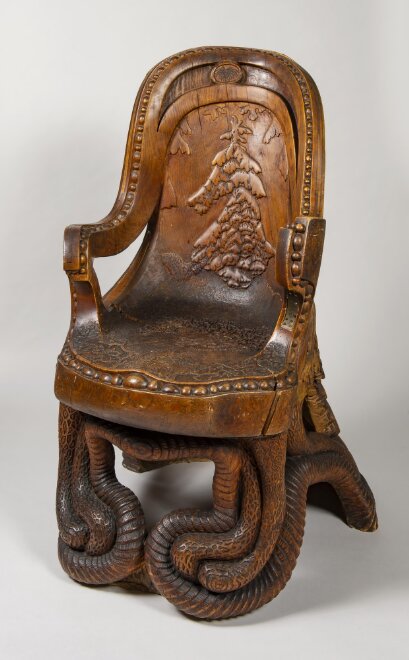
Artist: Knut Fjaestad
Title: The Seven-Year Throne
Description:
December 2018 - The Seven Years’ Throne by Knut Fjaestad
Nationalmuseum has recently acquired a so called “stabbestol” chair with large snow-laden branches build up the back. This unique chair was designed and carved by Knut Fjaestad and took seven years to manufacture and it was completed in 1914. The length of the process earned the chair its name, The Seven Years’ Throne.
Knut Fjaestad (1860-1937) began carving wooden furniture around 1907, when he bought Bjälbo, an 18th century house located on Skärsätra gård on Lidingö island. He had previously worked as a merchant in the Old Town of Stockholm. Knut was inspired to craft the chair when he saw the stabbestol chair which his younger brother Gustaf Fjaestad (1868–1948) had made for Ernest Thiel (1859-1947). Gustaf had carved stabbestol chairs since 1894, when the earliest known examples of the style were manufactured. This type of chair was produced and got its shape from the material from which it was fashioned – namely, a log. The most famous Gustaf Fjaestad furniture group is the large sofa group that he created for Thiel, and which is now on display at the Thiel Gallery. Unlike his brother, who studied at the Royal Academy of Fine Arts and the Swedish Artists’ Association school, Knut was an autodidact (an uneducated artist).
Knut Fjaestad’s artistic activity can be said have been shaped by two trends. On the one hand, he worked in an era characterized by a passion for all things artistically unique and handmade, heavily influenced by the British Arts and Crafts movement active at the end of the 19th century. At the same time, a national variant of the Art Nouveau style was developing in Sweden. Fjaestad transformed these two movements and left his own mark on them through his handmade, carved furniture. He worked at a time when Swedish motifs were particularly central in the country’s art; Richard Bergh (1858-1919) was among the artists to emphasize them. The artists searched for the mysterious inner essence of man and nature and what they perceived as genuinely Nordic. Bergh elevated the gnarled scrub pine – stunted and gnarled as a result of having grown in a harsh, windy, and nutrient-poor environment – into the symbol of Swedish art.
Knut Fjaestad himself called his carved wooden furniture “fantasy works” and first presented them at an exhibition at Birger Jarlsgatan in Stockholm in 1923. The contemporary press discussed these pieces of furniture, noting that “they do not remind us of anything we have seen before, neither of antiquity nor of the present, Rococo nor futurism; rather, they are completely distinctive.” Each piece of furniture was uniquely designed and the material – stumps and logs of both spruce and birch – decided what kind of furniture it would become. To produce the relief work and surface texture of the furniture, Fjaestad carved, oiled, tarred, and burned the wood. The white surfaces were added by scrubbing the wood. Through this acquisition, the museum has expanded its collection of furniture from the period. Nationalmuseum already has a stabbestol chair by Gustaf Fjaestad, but this is the first work by Knut Fjaestad to be added to the collections.
The acquisition is a gift from Ann Stern through the Friends of Nationalmuseum.
| Datafält | Värde |
| Title | The Seven-Year Throne |
| Designed and made by | Knut Fjaestad, Swedish, born 1860, dead 1937 |
| Technique/Material | Cut fir-tree |
| Dimensions | Dimensions 116 x 72 x 83 cm |
| Dating | Made 1908 - 1915 |
| Acquisition | Purchase 2018 Ann Stern Fund through Nationalmusei vänner |
| Inventory number | NMK 194/2018 |

Artist: Hubert Robert
Title: View of the Grotto in the Landscape Garden at Méréville
Description:
November 2018 - Boats in Front of the Grotto in the Park at Méréville by Hubert Robert
Nationalmuseum recently acquired a small painting by Hubert Robert that shows a view of the park in Méréville, probably executed in 1786-87. Robert has primarily become known for his picturesque vedute of Rome, often composed of a fantasized conglomeration of various famous ruins and monuments. His work as a garden designer is less known. The newly acquired painting was created in connection with the work Hubert Robert carried out in the park at Méréville for the wealthy banker, the Marquis Jean-Joseph de Laborde.
The French artist Hubert Robert (1733-1808), also known as "Robert des ruines,” is primarily associated with his magnificent and picturesque views of Rome, where he lived for more than a decade starting in 1754. Upon his return to Paris in 1765, he was already a big name and continued to create fantasy pictures featuring combinations of various monuments, so-called capriccios, as well as views of Paris. Robert kept working with the theme of ruins, as well as related topics such as fires and destruction.
Robert’s artistic merits soon also led to his appointment as Royal Garden Designer, dessinateur des Jardins du Roy. However, Robert had very little in common with his renowned predecessor, André Le Nôtre, because he does not appear to have ever transformed any of his blueprints into actual gardens. Instead, his primary contributions were drawings and paintings depicting various views of the planned landscaping projects. Nor is there much evidence that Robert himself staked out any parks on the basis of his artistic creations. His paintings instead served as advertising images intended for the client. At the same time, they could serve as a guide for the different specialists, of which Robert was the coordinating force. These included architects, sculptors and gardeners. Without their help, he would never have been able to realize some of his ideas for gardens and parks. Robert was thus more of an entrepreneur and designer.
The recently acquired painting is almost certainly an example of Robert’s unique method of using oil paintings to create gardens and parks, in this case Méréville, located 65 km southwest of Paris. Robert was employed by its owner, the Marquis Jean-Joseph de Laborde, in 1786. The entire project came to an abrupt end when the Marquis was guillotined in 1794. Up until that date, feverish activity and extensive construction work was carried out in the park. In addition to a variety of pavilions and monuments, several artificial grottos were added. Robert had experience with such work, including from Versailles, where a decade earlier he created a picturesque grotto formation around François Girardon and Thomas Regnaudin’s 17th century sculpture group, Les Bains d'Apollon, in one of the garden installations. Robert brought the same artists with whom he had worked at Versailles to Méréville, among them the sculptor Yves-Éloi Boucher, nephew of the famous François Boucher. He and several others are mentioned in Robert's correspondence with the Marquis de Laborde as being responsible for creating three-dimensional models for the large caves in Méréville. Among other resources, Robert’s paintings, such as Nationalmuseum’s recent acquisition, served as inspirations and guides for the endeavor. Boats in Front of the Grotto in the Park at Méréville may be compared to Robert’s other paintings in Nationalmuseum with views from Méréville (NM 2794-2795 NM), which depict the large grottos, the cascade, the rustic wooden bridge, and the pavilion.
The acquisition of the painting by Robert has been made possible by funds from the Hedda and N.D. Qvist Memorial Fund.
| Datafält | Värde |
| Title | View of the Grotto in the Landscape Garden at Méréville |
| Artist | Hubert Robert, French, born 1733-05-22, dead 1808-04-15 |
| Technique/Material | Oil on canvas |
| Dimensions | Frame 37,7 x 47,3 x 4,7 cm, Dimensions 29 x 38 cm |
| Dating | Made 1786 - 1788 |
| Acquisition | Purchase 2018 Hedda and N.D. Qvist Fund |
| Inventory number | NM 7480 |

Artist: Uno Åhrén
Title: The Paradise, Cupboard
Description:
October 2018 - Uno Åhrén’s unique cabinet from 1924
In conjunction with the reopening of Nationalmuseum, the association Nationalmusei Vänner has donated Uno Åhrén’s unique cabinet called The Garden of Eden, also known as The Paradise Cabinet. It was displayed in a ladies’ drawing room, or a boudoir, at the 1925 Paris Exhibition, that was furnished by the architect Uno Åhrén. This cabinet is the only one that was made, which makes it not only a rarity of great international interest, but also an exquisite piece of designer furniture that sums up the Swedish Grace style of the 1920s.
For close to a century, Uno Åhrén’s (1897-1977) interior design of a ladies’ drawing room at the Paris Exhibition in 1925 was reduced to a well-known black-and-white photograph in the standard design history reference works. The furniture ended up in the hands of private collectors, but, fortunately, some of these pieces have in come on to the market in recent years. In 2011, Nationalmuseum acquired an armchair and table from Åhrén’s ladies’ drawing room with the aid of funds from the Barbro Osher Pro Suecia Foundation. The museum has now been given the exclusive cabinet that was part of the furnishings as a donation from Nationalmusei Vänner.
The cabinet is made with inlaid wood, which means that patterns have been created using different types of wood in thin veneer. The motif is paradise, where Adam and Eve are living among exotic plants and animals. The untrustworthy snake wriggles on the lid of the writing board, tempting them to eat the apple that grows in the Tree of Knowledge. The material is lavish. The inlaid wood on the sides and doors of the cabinet is made of Brazilian walnut, eucalyptus and tropical olive wood, while the writing board is made of African ebony. The cabinet doors feature glass of different geometrical shapes, and the light-red leather the cabinet is decorated with is visible inside of these. At the 1925 Paris Exhibition, the shelves held objects such as engraved glass from Orrefors. The handle, key and fittings are made of silver-plated metal.
Uno Åhrén was a city planner, architect and interior designer in the first half of the 20th century. After the 1925 Paris Exhibition he became one of the leading advocates of functionalism, among other things he was one of the members of the group that organised the 1930 Stockholm Exhibition. Åhrén’s participation in the Paris Exhibition became problematic for him. On one hand, the exclusive Swedish design with a high level of craftsmanship and artistic decorative quality gained great international acknowledgement. On the other hand, Åhrén experienced a professional crisis that lead to the exposition becoming a turning point for him. It was a visit to Le Corbusier’s Pavillion L’Ésprit Nouveau that made him re-evaluate his artistic work. Le Corbusier presented a modernist home in simple, austere shapes with monochrome, undecorated surfaces that would facilitate mass production.
His contact with Le Corbusier’s pavilion lead to Åhrén writing a very self-critical article called “Brytningar” (Divergences), in the 1925 annual book of Svenska Slöjdföreningen (Swedish Handicraft Association). However, he did not only distance himself from his own participation in the Paris Exposition, he also actively argued in favour of the modern design of functionalism. It was to be created by anonymous designers who were to be at the service of society without ever emphasising their own individual artistic ability. It is likely that Åhrén’s self-criticism became a contributing factor to his own interior design in the 1925 Paris Exhibition being treated as a parenthesis – a “youthful misstep” – in his career when the history of 20th century design was written. However, this does not prevent us from appreciating his exclusive interior design with furniture of exquisite quality today. Nationalmuseum has no budget of its own for new acquisitions, but relies on gifting and financial support from private funds and foundations to enhance its collections of fine art, design and applied art.
| Datafält | Värde |
| Title | The Paradise, Cupboard |
| Artist | Uno Åhrén, Swedish, born 1897, dead 1977 |
| Manufacturer | Mobilia AB |
| Technique/Material | Marquetry in Brazilian walnut, eucalyptus and tropical olive tree, writing desk in African ebony |
| Dimensions | Dimensions 202 x 92 x 57 cm [med skrivdel], Dimensions 27 cm [endast övre delen] |
| Dating | Designed 1924 |
| Acquisition | Gift 2018 Nationalmusei Vänner |
| Inventory number | NMK 1/2018 |

Artist: Ernst Fries
Title: The Waterfalls at Tivoli with the Ponte Lupo, Temple of Vesta, and Temple of Sibyl The Waterfalls at Tivoli with the Ponte Lupo, Temple of Vesta, and Temple of Sibyl
Description:
July 2018 - Three Travelling German Artists
Nationalmuseum has acquired three landscapes by travelling German artists. Ernst Fries’ The Waterfalls at Tivoli with the Ponte Lupo, Temple of Vesta, and Temple of Sibyl, Carl Morgenstern's View towards Sorrento, and Georg Eduard Otto Saal’s Study of Vermafossen Waterfall. Nationalmuseum’s collections previously contained no works of this kind by German artists.
The three new acquisitions will make it possible to more clearly illustrate the international tendencies of the artistic activity of the 19th century. Artists of different nationalities travelled to the same destinations and painted the same scene. The museum's collections include paintings of the same sites by French, Danish and Swedish artists, among others.
One obvious commonality in the three paintings is the distance to the subject – in all three cases, the artist chose to situate the famous site in the distance. The views invite the gaze to explore pathways, spaces, and buildings, and demonstrate how far-off landscapes and a long distance perspective became central to German art of the Romantic era. For example, the eponymous protagonist in Goethe’s The Sorrows of Young Werther prefers to consider landscapes at a distance, because this allows him to experience them through his imagination. From one side of a valley, he can use his gaze to climb up and down the steep precipices on the other side. Yet once he physically arrives there, the magic vanishes and his eyes seek out the next view in what has now become the distance.
The three newly acquired paintings seem to be imbued with the same relationship with nature and the landscape. One can think of their creation as an equivalent to the kind of distanced experience that Werther preferred to physical exploration of a place.
When Ernst Fries died at the young age of 31, he had not really had time to establish himself as an artist in Karlsruhe, where he settled after his four-year stay in Italy. Therefore, he did not leave behind a wealth of artistic production. Thus, Nationalmuseum’s newly acquired The Waterfalls at Tivoli is a rarity. Judging by the fresh painting style and sharp treatment of the light, this work was at least partially executed on location and en plein air, when the artist visited Tivoli in October 1826. Fries is said to have been particularly fascinated by cascades and grottoes, and it is tempting to see the image as an imaginatively rendered experience of one of the most famous and dramatic landscapes of its kind.
This acquisition has been made possible by a generous contribution from the Wiros Fund.
| Datafält | Värde |
| Title | The Waterfalls at Tivoli with the Ponte Lupo, Temple of Vesta, and Temple of Sibyl The Waterfalls at Tivoli with the Ponte Lupo, Temple of Vesta, and Temple of Sibyl |
| Artist | Ernst Fries, German, born 1801-06-22, dead 1833-10-11 |
| Technique/Material | Oil on canvas |
| Dimensions | Dimensions 56,5 x 73,5 cm, Frame 72 x 90 x 9 cm |
| Dating | Made 1826 |
| Acquisition | Purchase 2018 Wiros Fund |
| Inventory number | NM 7472 |
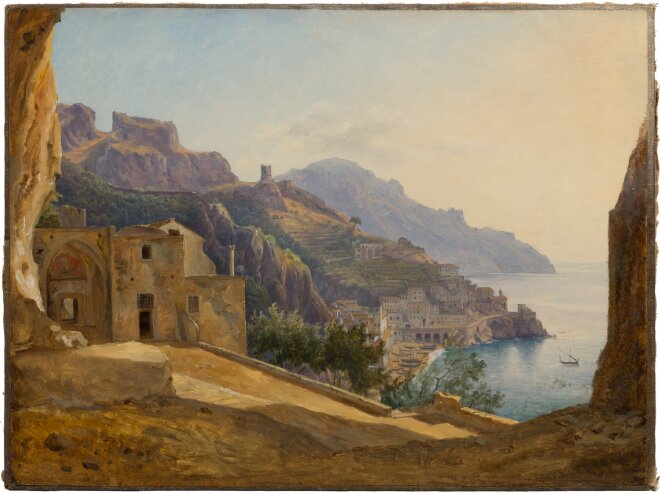
Artist: Carl Morgenstern
Title: View towards Amalfi from Grotta dei Cappuccini
Description:
July 2018 - Three Travelling German Artists
In 1834, Carl Morgenstern travelled to Italy, where he remained for three years. He painted extensively along the Amalfi coast and on Capri – two of the most important destinations for artists. His study from a point just above Sorrento demonstrates one of his specialties, a subtle atmospheric perspective in a pale blue-violet tone. It is particularly interesting that he sat in an opening in the rock, presumably to exploit the shadow that falls in the foreground and a bit into the picture, and so that he could paint the sun-drenched view without being bothered by the light.
This acquisition has been made possible by a generous contribution from the Wiros Fund.
| Datafält | Värde |
| Title | View towards Amalfi from Grotta dei Cappuccini |
| Artist | Carl Morgenstern, German, born 1811, dead 1893 |
| Technique/Material | Oil on paper mounted on canvas |
| Dimensions | Dimensions 38,5 x 52 cm |
| Dating | Made ca 1834 - 1837 |
| Acquisition | Inventoried 2018 (Purchase 2017 Wiros Fund) |
| Inventory number | NM 7447 |

Artist: Georg Eduard Otto Saal
Title: The Verma Waterfalls. Study
Description:
July 2018 - Three Travelling German Artists
German artists did not only travel to the south. Later in the century, Scandinavia became another popular destination – especially Norway, which could offer the most striking scenery, with waterfalls, mountains and fjords. Georg Eduard Otto Saal’s Study of Vermafossen Waterfall is painted entirely on site, in front of the subject. With its lively trees and roaring waterfalls, the painting is a very fine example of how artists developed a technique for achieving a high degree of illusion using the simplest and fastest possible brush strokes.
This acquisition has been made possible by a generous contribution from the Wiros Fund.
| Datafält | Värde |
| Title | The Verma Waterfalls. Study |
| Artist | Georg Eduard Otto Saal, German, born 1818, dead 1870 |
| Technique/Material | Oil on canvas |
| Dimensions | Dimensions 47 x 67,7 cm, Frame 56,4 x 76,8 cm |
| Dating | Made 1854-06 |
| Acquisition | Purchase 2017 Wiros Fund |
| Inventory number | NM 7433 |

Artist: Per Krafft d.y.
Title: Belisarius
Description:
June 2018 - A key work in Swedish Neoclassicism
Nationalmuseum has acquired a painting by Per Krafft the Younger (1777-1863) depicting the blind former general Belisarius. This painting ought to be regarded as one of the most prominent Swedish works executed in the French Neoclassical style.
In 1796, at the age of nineteen, Per Krafft the Younger was awarded a travel scholarship by the Royal Swedish Academy of Fine Arts, in part because Jonas Åkerström (1759–1795), who had used the scholarship to spend time in Rome, had suddenly died the year before at the early age of 36. Krafft went to Paris where as the only Swede he spent three years studying under Jacques-Louis David (1748–1825). David had a large number of pupils, and his teaching, which in those days was held at the Louvre, laid emphasis on painting and drawing technique, modelling and nature studies in order to depict only the ideal subject matter: themes from antiquity.
David’s influence is evident in Krafft’s painting, which ought to be regarded as one of the most prominent Swedish works executed in the French Neoclassical style. It shows the strict lines of classical architecture in the background and a sculptural approach to the figure drawing. The palette is also a reminder of David’s work, with fine contrasts between their clothing – white and green and red – worn by Belisarius and the boy, their skin tone and the shiny surface of the reflective metal on the belt and helmet. The figures almost stand out in relief against the light brown, yellow and blue-grey tones of the background. The work was executed in 1799 and sent together with three other paintings – Phrygian lyre player meditating, Paris and Love – to Stockholm for exhibiting at the Royal Academy of Fine Arts in 1801.
The motif showing the successful Byzantine general Belisarius who was reduced to beggar status proved popular in the latter part of the 18th century as a result of the novel Bélisaire by Jean-François Marmontel (1723–1799) which was published in 1767. As a punishment for the general who was suspected of having conspired against him, the Byzantine emperor Justinian I is alleged to have put out Belisarius’ eyes, after which Belisarius was forced to beg by the gates of Rome. This choice of motif gave Krafft the opportunity to direct criticism in allegorical form at the tyrannical rulers of his day. Nor is it altogether surprising that Krafft’s teacher, the Republican David, had used the motif in a famous painting from 1781, now on display in the Palais des Beaux-Arts in Lille. A further famous example was executed by another of David’s pupils, François-Pascal-Simon Gérard (1770–1837), now on display in the J. Paul Getty Museum in Los Angeles.
Krafft emphasises the pathos of his subject in the sober mood that permeates his work in general and in the detail in particular, such as the way the old soldier uses his helmet to collect the alms received. Per Krafft the Younger enjoyed a long life. He was appointed court painter and professor at the Royal Academy of Fine Arts. During his career he was to become primarily a portrait painter.
This acquisition has been made possible by a generous donation from the Hedda & N.D. Qvist Memorial Fund.
| Datafält | Värde |
| Title | Belisarius |
| Artist | Per Krafft d.y., Swedish, born 1777-01-11, dead 1863-12-11 |
| Technique/Material | Oil on canvas |
| Dimensions | Totalmått 8 cm Monterad i ram, Dimensions 125 x 94 cm , Frame 138,5 x 104,5 x 5 cm |
| Dating | Made 1799 |
| Acquisition | Purchase 2018 Hedda and N.D. Qvist Fund |
| Inventory number | NM 7468 |

Artist: Salvator Rosa
Title: A Rocky Landscape with a Tree and Two Figures
Description:
May 2018 - Drawing by Italian master Salvator Rosa
Nationalmuseum has acquired a work by one of the foremost Italian artists of the seventeenth century, Salvator Rosa (1615-1673). The work belongs to a distinct and important category within Rosa’s artistic production, his panel drawings. With the acquisition, Nationalmuseum is now second only to the Pitti Palace in Florence in having such a distinguished collection of this type of work by the artist.
Salvator Rosa was both one of the most prominent Italian artists of the seventeenth century and one of the most unconventional. He pursued the visual arts, as well as poetry and acting. He was very well read and his art often had a literary source. Rosa often portrayed historical and mythological motifs in unexpected and innovative ways. Though he frequently selected obscure, seldom depicted aspects of well-known stories, he was nonetheless able to capture their essence.
Rosa was also influential in the development of landscape painting. Like his other work, Rosa’s landscapes featured biblical and mythological motifs. In addition, he painted landscapes of a type that came to be known as “Paesaggio con banditi” or “Landscape with bandits”. In these works, bands of bandits travel through open landscapes with vistas taken from Campagnano, the lowlands near Rome; from the environs of his home town Naples; and from Abruzzo and Calabria. Here one senses a romanticized interplay between the bandits’ free-ranging lifestyle and the untamed countryside. Perhaps one even gets a sense of nature being imbued with spirituality, an impulse given fuller expression in the painting of the Romantic period. It is hardly surprising that Rosa’s work, especially his landscapes, would enjoy great popularity at the end of the eighteenth and beginning of the nineteenth centuries. This was especially true among artists representative of romantic landscape painting in England.
In the current work, Rosa has placed a gnarled tree at center in the foreground. Two figures, possibly bandits, can be seen on a rocky outcropping near the tree. To great effect, Rosa integrates the brown coloring and rough texture of the panel into his motif. He uses white accents to create dramatic lighting, possibly a depiction of the moment just before sunset.
The tree and rocks in the foreground seem almost to project outward from the panel as they are drawn in such contrast to the silhouetted mountain in the background.
Salvator Rosa’s panel drawings constitute a unique body of work with specific qualities that provide an interesting comparison to the remainder of his artistic production. Frequently, the panels used for the drawings were retrieved from wooden crates. It is also possible in some cases that Rosa made drawings to decorate the crates prior to their use, for example, in transporting artworks to his friend and benefactor Giovanni Batista Ricciardi. Earlier works of this type include Nationalmuseum’s The Abandoned Oedipus (NM 6839) and The Death of Empedocles, part of the Pitti Palace collection in Florence. The Oedipus motif can also be found in an engraving by the artist similar to the named drawing, while that of Empedocles can likewise also be found in a painting. Even so, both drawings appear to be fully conceived works in their own right — as is the recently acquired work. It is possible that these drawings originally served as conversation pieces intended to stimulate intellectual exchange with Ricciardi. Given that the drawings are rendered on a surface traditionally used for painting, works such as these have often been challenging to group in traditional categories. The dimensions of the current work match closely those of previously known works from this group.
New research about this type of work has emerged during the past few years, and in the near future, more will be shared in the publication “Art Bulletin of Nationalmuseum”.
Recent acquisitions have been made possible through a generous donation from the Wiros Fund (Wiros-fonden).
| Datafält | Värde |
| Title | A Rocky Landscape with a Tree and Two Figures |
| Artist | Salvator Rosa, Italian, born 1615, dead 1673 |
| Technique/Material | Pencil, pen and ink with white heightening on wood |
| Dimensions | Frame 71 x 51 x 5 cm, Dimensions 61,1 x 39,9 cm |
| Dating | Utf. 1600-talet |
| Acquisition | Purchase 2017 Wiros Fund |
| Inventory number | NMH 219/2017 |

Artist: Edward Steichen
Title: Greta Garbo (1905–1990), Actress, 1928 (print c. 1961)
Description:
March 2018 - Greta Garbo by Edward Steichen
Nationalmuseum has acquired a portrait of film legend Garbo, produced in 1928 by American photographer Edward Steichen. It was part of an entire series published in Vanity Fair. The portrait is an interesting example of contemporary avant-garde photography involving an extreme close-up.
Graham Greene wrote with great admiration about Garbo in film reviews in the 1930s. Roland Barthes analysed her face in the essay “Le Visage de Garbo”, published in Mythologies (1957). David Bowie sang “I’m the twisted name on Garbo’s eyes” in Quicksand on the album Hunky Dory (1971). The myth of Garbo is far greater than the sum of Greta Gustafsson’s (1905-1990) life and roles. More than seventy-five years after the premiere of her last film, she is still the most internationally renowned Swedish actress. Paradoxically, the photographic still image of the actress' face is more famous today than her role interpretations and films.
Most of the well-known pictures of Garbo are role portraits produced by still photographers who worked for her American film company Metro-Goldwyn-Mayer, e.g. Ruth Harriet Louise and Clarence Sinclair Bull. In addition to this, photos by Arnold Genthe, Edward Steichen and Cecil Beaton have also reached iconic status. Arnold Genthe took the first pictures of the then newly arrived actress for the US launch in Vanity Fair in 1925. The portrait was published under the heading A New Star from the North. In these early pictures, Garbo had not yet been styled to the persona later created for her in Hollywood. Cecil Beaton’s portrait, produced in 1946, shows Garbo with almost no makeup following the end of her career. She had then become one with the film industry's official image. Although she no longer starred in any new films, it was difficult to distinguish the person from the characters in her previous roles.
One of the films where Garbo played a femme fatale, elegant and seemingly spoiled but ultimately noble and self-sacrificing, was A Woman of Affairs. In connection with the 1928 production, Edward Steichen took a number of portraits for Vanity Fair. He was bothered by the curly haircut that Garbo's character Diana Merrick had in the film. The photographer wanted to show more of her famous face. The actress therefore used her hands to smooth and hold back her hair. From this session, there are both pictures of Garbo with unruly curly hair and stripped down portraits with her hair pulled back and her face in centre.
Nationalmuseum has now acquired one of Steichen’s portraits, thus filling a gap among the Garbo photographs already included in the National Portrait Gallery. This study is a close-up that gets closer to the Divine face than most in the Steichen series. In a charged close-up, the actress's intense gaze is directed towards the camera lens and thus indirectly at the observer. However, the idea of having the face framed by the hands was not entirely new. The year before, Ruth Harriet Louise used the same gesture when she photographed Garbo's role portrait for the now lost film The Divine Woman, directed by Swede Victor Sjöström. The gesture is also repeated later, including in Clarence Sinclair Bull's photo of Garbo in her first talking film Anna Christie (1929). Through this composition, the photographers placed the focus on Garbo's soulful eyes and her face's classically clean lines. Steichen’s version is still among the most famous portraits of Garbo.
Edward Steichen (1879-1973) had a long career as an influential American photographer. His debut around 1900 coincided with pictorialism, a movement that pushed for the acknowledgement of the art of photography. These photographers strived to depart from pure depiction and worked very consciously with composition and visual effects. During the period 1947-62, Steichen was also the director for the collection of photos at the Museum of Modern Art in New York. In this way he influenced both contemporary photography and the historiography in this area. The year before his retirement, the museum celebrated the 82-year-old photographer with a major retrospective, Steichen the Photographer. The now acquired Garbo portrait is a reprint that the artist produced particularly for this exhibition.
The acquisition of Edward Steichen’s portrait of Greta Garbo has been made possible through contributions from the Fritz Ottergren Fund, as well as donations by Ulla and Grunnar Trygg.
| Datafält | Värde |
| Title | Greta Garbo (1905–1990), Actress, 1928 (print c. 1961) |
| Photographer | Edward Steichen, American, born 1879, dead 1973 |
| Technique/Material | Gelatin silver print, flush-mounted on board |
| Dimensions | Dimensions 42,5 x 34 cm |
| Dating | Made 1928, Made 1961 (?) |
| Acquisition | Purchase 2017 Fritz Ottergren Fund and Ulla and Gunnar Trygg Fund |
| Inventory number | NMGrh 5159 |

Artist: François Chauveau
Title: The Entry of Queen Christina of Sweden into Paris on 8 September 1656
Description:
February 2018 - A 17th century drawing by François Chavueau of Queen Kristina entering Paris in 1656
The Nationalmuseum has acquired a drawing by François Chauveau depicting the procession of Queen Kristina’s solemn entry into Paris on 8 September 1656. She was then at the height of her sovereign fame and large crowds of people had gathered on the streets of the city to get a glimpse of the Queen. Until now, the drawing has been part of a private art collection in France.
Following her abdication, Queen Kristina left Sweden in the summer of 1654. A year later, just before Christmas in 1655, she arrived in Rome without any definite plans for the future. The following summer, she set off for Paris. She was officially thought to be going to Sweden to negotiate about her financial allowance but in fact, her intentions could not have been more different. She had secretely been conferring with the leader of France, Cardinal Mazarin, about launching a military attack on southern Italy, the success of which would make Kristina the Queen of Naples. Eighteen- year-old King Ludvig XIV was initiated into the plans and subsequently, gave the order that Queen Kristina was to be received in France as a soverign ruler.
François Chauveau (1613 – 1676) were soon recognised for his graphic drawings. Many literary works were illustrated by François Chauveau whose etchings were either based on his own drawings or those of other people. In the 1660s, he was commissioned by Ludvig XIV to engrave images of the tournament organised in celebration of the birth of his son and successive heir in 1662, an assignment that earned him the title ’Royal Engraver’. Royal festivities and ceremonies were usually documented by way of graphic drawings. The drawings and pictures were arranged to vividly recount the course of events, much like the news graphics of today. The engravings gave an official picture of the (often very expensive) festivities, the purpose of which was to impress both foreign and domestic subjects. There are a number of engravings that depict Queen Kristina’s solemn entry into Paris and this drawing is most likely an outline for such an engraving. Another exquisitely detailed drawing signed by ’Chauveau’ can be found in the French National Library.
The long procession is here seen winding its way towards Notre Dame as faintly shown in the top right-hand corner. In the foreground, Queen Kristina can be seen riding sidesaddle and holding a walking stick. In front of her, four officials are each carrying a canopy. One of the canopies, embroidered with the Coat of Arms of Sweden, was handed over to the Queen at the city gate with the intention that she would ride underneath it when entering the city. However, according to the newspaper La Gazette, her horse Licorne (”Unicorn”) shied away from the canopy and hence, it had to be carried in front of the Queen.
A year later, the French tributes to Queen Kristina gave way to indignation and hatred when the Queen had her Royal Equerry by the name of Monaldesco executed at the Castle of Fontainebleau after he had betrayed and thus, foiled her plans of becoming the Queen of Naples.
The acquisition of this drawing was made possible due to a bequest from the Wiros Fund.
| Datafält | Värde |
| Title | The Entry of Queen Christina of Sweden into Paris on 8 September 1656 |
| Artist | François Chauveau, French, born 1613-05-10, dead 1676-02-03 |
| Technique/Material | Pen and brown ink, brown wash |
| Dimensions | Frame 50 x 64 x 3 cm, Dimensions 41,2 x 54 cm |
| Dating | Made 1656 |
| Acquisition | Purchase 2017 Wiros Fund |
| Inventory number | NMH 63/2017 |

Artist: Agnes de Frumerie
Title: Struggle for existence (Source d'or)
Description:
January 2018 - The sculpture ”Struggle for existence” by Agnes de Frumerie
Nationalmuseum has acquired a piece created by the Swedish sculptor Agnes de Frumerie (1869-1937) in collaboration with the French ceramist Edmond Lachenal (1855-1948). The sculpture, which is a nearly one meter tall relief made of glazed stoneware, depicts a group of people in an arc shaped opening. According to older sources the title of the piece is “La Source d’Or” and has in Swedish been called “Kampen för tillvaron” (“Struggle for existence”), which appears to allude to a seemingly endless struggle for existence and the pursuit of wealth, where only the strongest survive.
The people portrayed in the foreground of this peace have a resigned appearance and are embracing and supporting each other. In the background one can see clutter of people who are appearing to reach for a rainfall that is falling down from the sky. The signature on the bottom of the sculpture reads “Agnes de Frumerie 1900” and on the back it reads “E. LACHENAL Céramiste á Châtillon Seine 1900”.
Agnes Kjellberg was born in Skövde in 1869. She moved to Stockholm at the young age of 14 in order to study at University College of Arts, Crafts and Design with the ambition of becoming an art teacher. In 1886 she was accepted into Royal Academy of Fine Arts. After several medals and an extended stay in Berlin she was one of the first women to win the large travel scholarship in 1892 and she moved to Paris with her mother. She soon married artillery captain, masseur and subsequent doctor Gustaf Frumerie, and they would remain in Paris for 30 years. In the 1890’s the couple de Frumerie socialized with the Swedish art avant-garde in Paris: Strindberg, the Ericson-Molard couple, Christian Eriksson, to name only a few. In the artistic world Agnes de Frumerie was in the center of the Paris art scene.
During her scholarship years she accounted for everything in letters to the Royal Academy of Fine Arts in Stockholm. Starting in 1893 Frumerie displayed her work at the Salon des Artistes Franҫais and starting in 1895 also at the new salon Salon National des Beaux Arts at the Champs de mars. In 1897-1908 she was also in collaboration with the French ceramist Edmond Lachenal and she displayed her work many times at his exhibitions at Galerie Georges Petit. Agnes de Frumerie was also highly involved in the association of female artists – Union des Femmes Peintres et Sculpteurs – which was formed in 1881, and in 1895 she began to display her work there on a regular basis.
For a long time it was assumed that Agnes de Frumerie studied under Auguste Rodin (1840-1917). This was not the case; instead Frumerie was advised by Rodin to work independently. However, she was one of the Swedish sculptors who were clearly influenced by the French masters. She realized early on how innovative Rodin was and referred to him as a “contemporary Michel-Angelo”. In her statues, de Frumerie resembled Camille Claudel (1864-1943), who even accused de Frumerie of plagiarism.
The influence from Rodin is also clearly visible in this relief. Just like in Rodin’s Gates of Hell, the general composition consists of a mishmash of human bodies in high and low relief. The emphasis is on creating a feeling, which the facial expressions, gestures and looks all contribute to. The ambition that the sculptures had to create monumental pieces surrounding large, universal subjects was in keeping with the spirit of those times.
Also typical for the times was the experimentation with different techniques in arts and crafts. Edmond Lachenal developed the technique with glazed stoneware in different colours, “email mat velouté” (eng: mat velvet opaque glaze) in the 1890’s and he collaborated with different sculptors, of whom Agnes de Frumerie was one of the most significant. This piece by Frumerie and Lachenal was displayed at the Exposition de l’Union des femmes peintres et sculpteurs and at the Galerie Georges Petit in 1900. The model of the sculpture can be found at Västergötland’s museum in Skara.
The acquisitions have been possible through a generous contribution from the Hedda and N.D. Qvist’s Memorial Fund.
| Datafält | Värde |
| Title | Struggle for existence (Source d'or) |
| Artist | Agnes de Frumerie, Swedish, born 1869-11-20, dead 1937-04-02, Edmond Lachenal, French, born 1855-06-03, dead 1948-06-10 |
| Technique/Material | Stone ware, matte velvet opaque glaze |
| Dimensions | Dimensions 84 x 74 x 25 cm |
| Dating | Made 1900 |
| Acquisition | Inventoried 2018 (Purchase 2017 Hedda and N.D Qvist Fund) |
| Inventory number | NMSk 2362 |