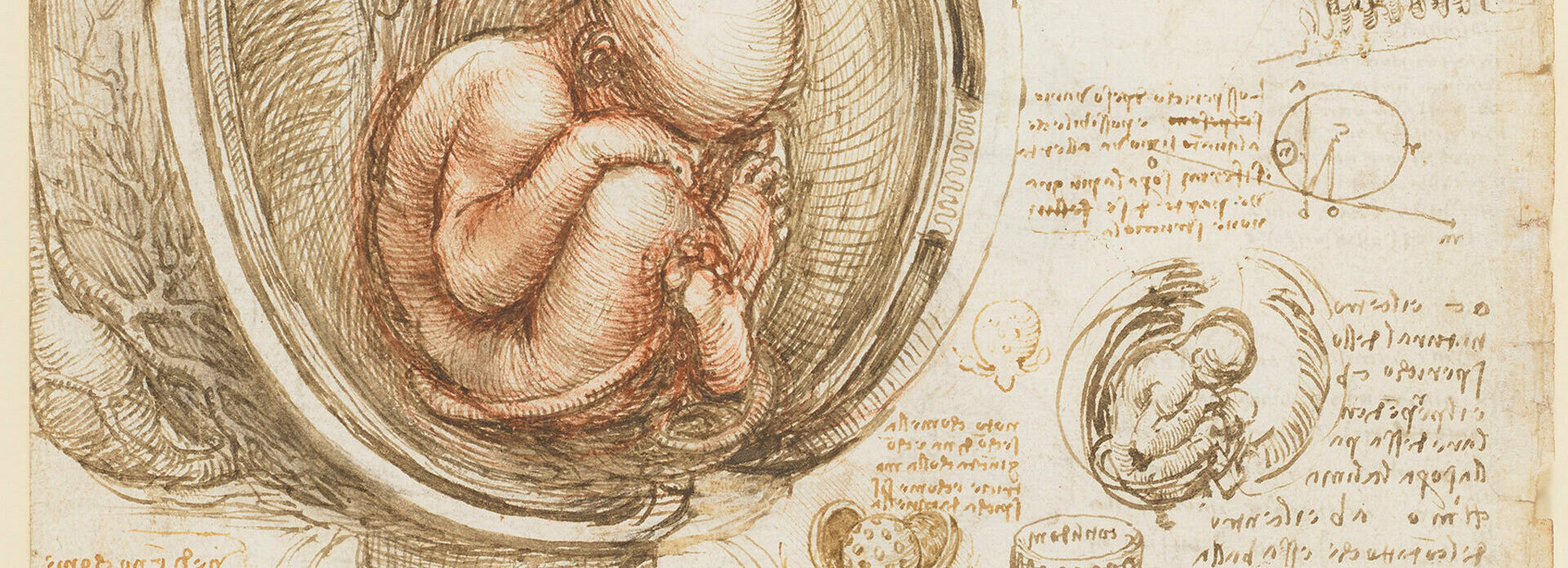
The anatomical drawings of the female body and the fetus in the womb by Leonardo da Vinci (1452–1519) are among the most fascinating and modern aspects of his production as an artist and thinker. In this year’s Tessin lecture, The American art historian Dr. Carmen C. Bambach, curator in the Department of Drawings and Prints at The Metropolitan Museum of Art, explains why.
Date and time
Friday 13 November, 15:00–16:00
Admission
Free
Seat reservations
Limited number of seats; advance seat reservation required
Tickets will be released shortly
Location
Nationalmuseum, The South Courtyard, ground floor.
Language
English
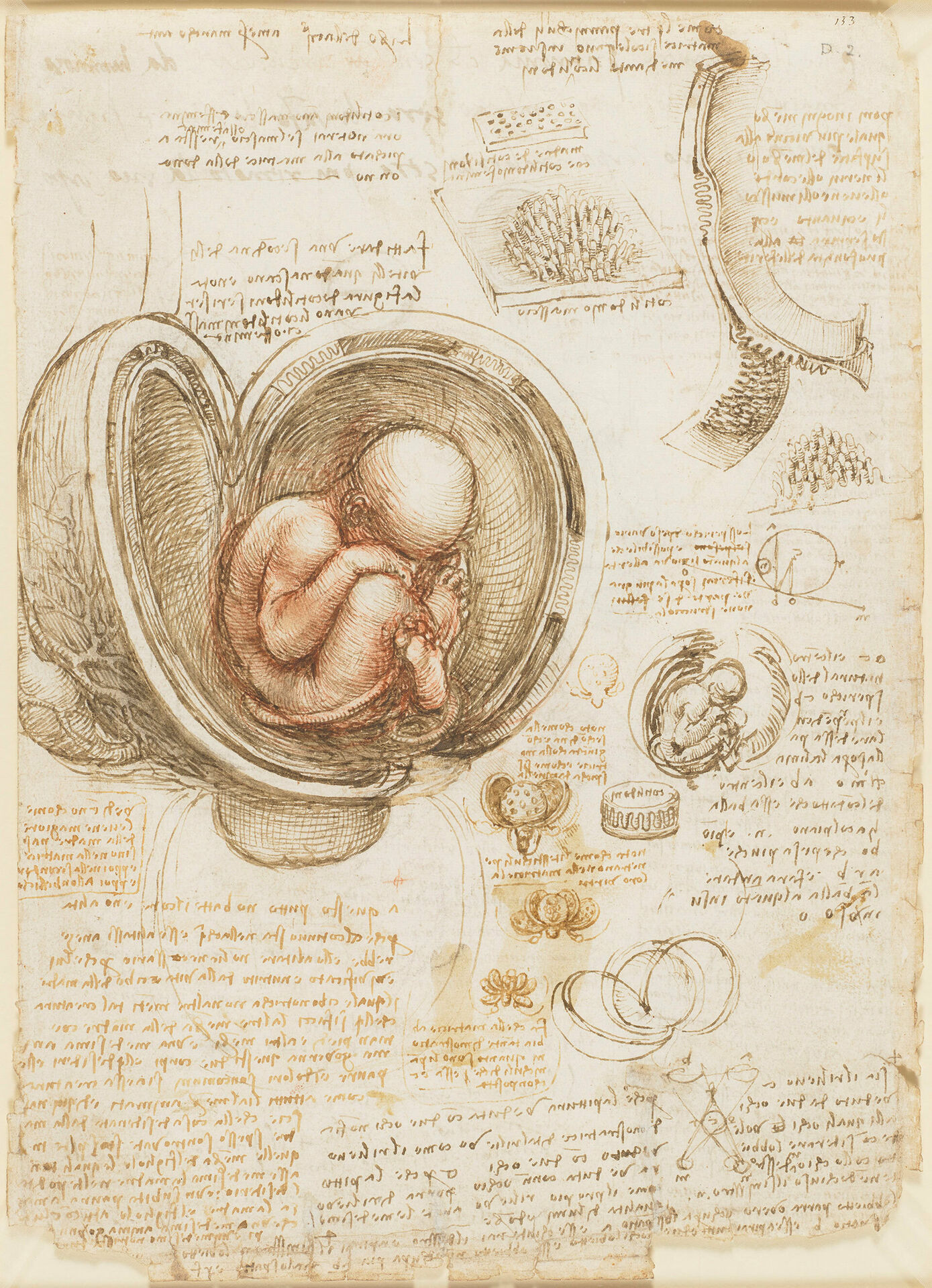
Leonardo da Vinci, the human fetus in utero; blown-up details of the cotyledons, and other details, (recto), ca. 1510–1511. Pens with nibs of different thickness and different hues of brown ink, with underdrawing and overdrawing by the artist in red chalk (the fetus in the main design). From the Anatomical MS C.III, fol. 8r. Windsor Castle, Royal Library RCIN 919102r. © Royal Collection Enterprises Limited 2026 | Royal Collection Trust
The drawings communicate anatomical forms with an extraordinary emotive power, as well as great naturalism and fidelity of detail. Why were these drawings so important to the artist? How are they a product of their time and how do they transcend their time?
Dr. Bambach will discuss these anatomical drawings in the context of Leonardo’s career and will situate them within the larger Western history of scientific illustration.
Leonardo’s anatomical research and philosophy as an artist were rooted in questions about the origins of human life, and he investigated the female body and the pregnant womb at a time when the mortality rates of infants and women of child-bearing age were devastatingly high. Leonardo invented scientific methods of anatomical research, together with groundbreaking visual languages to express them, based on his reading of earlier authors, his own observations from nature, and his intense campaigns of dissection in 1507–9 and 1510–13.
Around 1503–1505 Leonardo acquired a major compendium of medical writings attributed to Johannes de Ketham “Alemanus,” and read this reference book in the Italian edition as a complement to his anatomical research. Ketham termed the female organs of reproduction and their functions the “secrets of woman” (de secretis mulierum and secreti della donna).
Leonardo annotated his anatomical drawings with much explanatory text and aimed to convey the three-dimensional forms of organs with clarity and precision of detail. His visual reasoning and level of observed detail were an immense contribution to the history of art and science, given that before him Medieval and early Renaissance treatises discussed anatomy with virtually unillustrated text.

Carmen C. Bambach. Photo: © Eileen Travell_The Imaging Department_The Metropolitan Museum of Art
About Dr. Carmen C. Bambach
Dr. Carmen C. Bambach is Marica F. and Jan T. Vilcek Curator in the Department of Drawings and Prints at The Metropolitan Museum of Art. She has organized and co-organized seven exhibitions at The Met, has authored more than 80 scholarly articles and teaches and lectures widely in Europe and the U.S.
Biography in detail
Fellow of the American Academy of Arts and Sciences.
Her exhibition Raphael. Sublime Poetry at The Metropolitan Museum of Art, ending on June 28, 2026, was accompanied by her catalogue, and was seen by 562,075 visitors. It was positively reviewed in the popular and scholarly press.
On June 14, 2022, she received the Mongan Prize from Villa I Tatti, The Harvard University Center for Italian Renaissance Studies, for her contribution as a scholar of Italian Renaissance art and connoisseurship.
For her book Leonardo da Vinci Rediscovered (Yale University Press, July 2019, 4 vols.) she received the International Leonardo da Vinci Prize, Vigevano (Italy), September 2019, and the R.R. Hawkins Award (the top Prize of the 2020 PROSE Awards) from the Association of American Publishers, June 2020.
She also received the Inaugural Vilcek Foundation Prize for Excellence for her contribution to U. S. society and culture as an immigrant, April 4, 2019.
Her Michelangelo Divine Draftsman and Designer accompanying her exhibition at The Met, won the Phyllis Goodhart Book Prize of the Renaissance Society of America in 2019, and also from the Association of American Museum Curators in 2018.
She was Andrew W. Mellon Professor in 2010-12 at CASVA (Center for Advanced Study in the Visual Arts), National Gallery of Art.
Her books include Drawing and Painting in the Italian Renaissance Workshop: Theory and Practice, 1300-1600 ("Premio Salimbeni 2000”).
The Tessin Lecture:
Once a year the Nationalmuseum, Stockholm, invites a prominent international scholar to give a lecture in art history. The lecture, which is public, is a way to pay tribute to an exceptional scholar in art history and emphasize the museum’s commitment to research.
[Bild finns. Bildtext: Leonardo da Vinci, the human fetus in utero; blown-up details of the cotyledons, and other details, (recto), ca. 1510–1511. Pens with nibs of different thickness and different hues of brown ink, with underdrawing and overdrawing by the artist in red chalk (the fetus in the main design). From the Anatomical MS C.III, fol. 8r. Windsor Castle, Royal Library RCIN 919102r. © Royal Collection Enterprises Limited 2026 | Royal Collection Trust
The Tessin Lecture:
Once a year the Nationalmuseum, Stockholm, invites a prominent international scholar to give a lecture in art history. The lecture, which is public, is a way to pay tribute to an exceptional scholar in art history and emphasize the museum’s commitment to research.