The Art Bulletin of Nationalmuseum Stockholm is a journal devoted to art history. It is published in English with a content that ranges from older master paintings to contemporary design. This, volume 30, includes articles on acquisitions in 2023 as well as several articles in art history on works in the museum's collections.
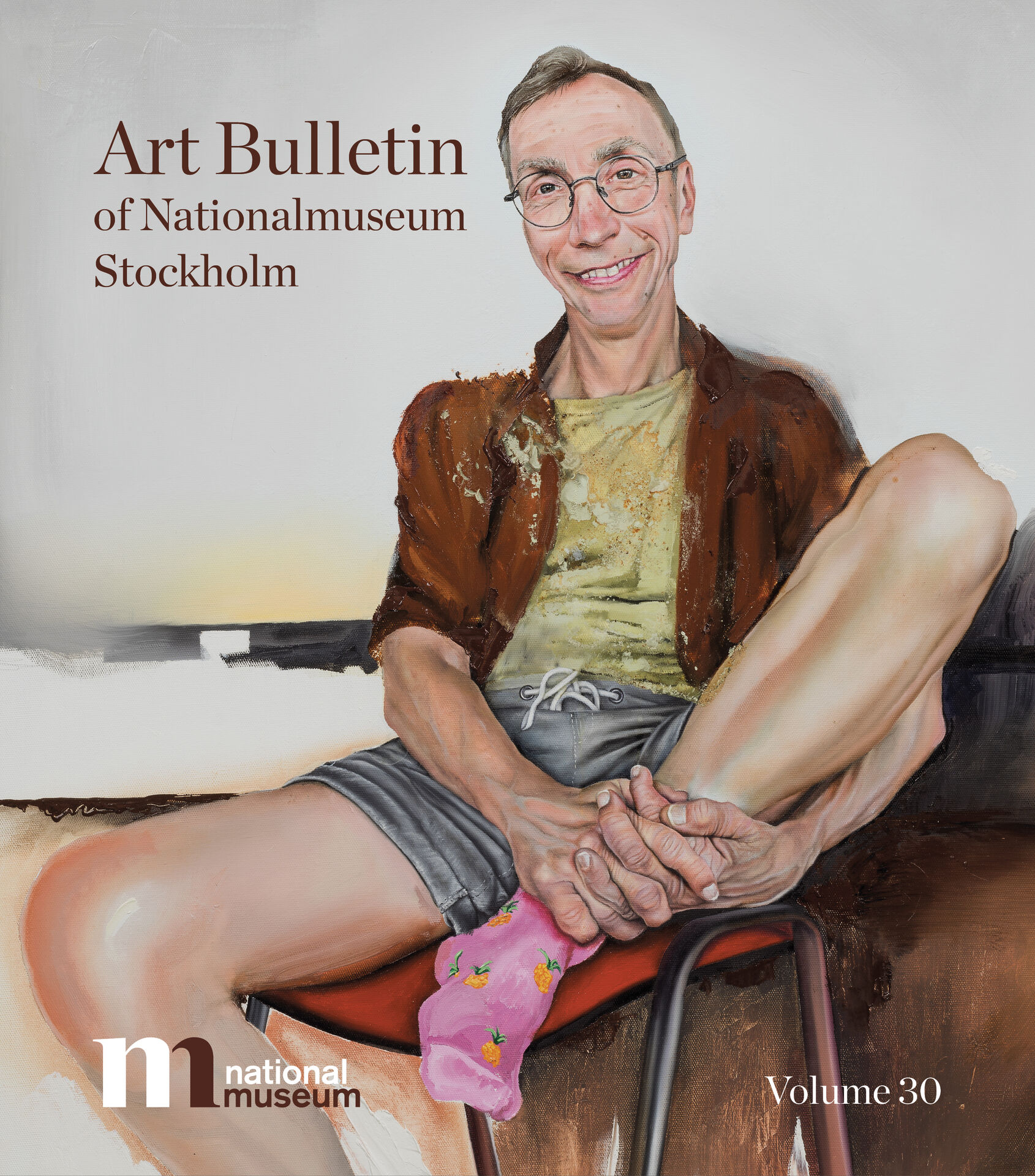
Sixten Sandra Österberg, Svante Pääbo, NMGrh 5315. Cover of volume 30.
The Art Bulletin is published through DiVA (a publishing system for research publications and student essays and a digital archive for long-term preservation of publications). You can also reach it via the links below. You can open, or download the publication in its entirety, or the articles separately.
Download Art Bulletin Volume 30, high resolution pdf
Download Art Bulletin Volume 30, low resolution pdf
Articles
Preface
Patrick Amsellem
Acquisitions
A Recently Acquired Genre Painting by a Rembrandt-pupil: A Young Man Asleep Before an Open Book
Carina Fryklund
The article examines A Young Man Asleep Before an Open Book, a mid‑17th‑century genre painting recently acquired by the Nationalmuseum and attributed to a pupil within Rembrandt’s studio. It situates the work within Dutch moralising traditions, interpreting sleep and idleness as signs of sloth (acedia). Through stylistic and iconographic analysis, the author argues that the painting reflects advanced yet imperfect mastery, characteristic of an accomplished Rembrandt pupil rather than the master himself.
Samuel Cooper and Richard Gibson – Two Unique Examples of English Master Drawings
Magnus Olausson
Recent acquisitions by the Nationalmuseum include two rare 17th‑century English chalk drawings by Samuel Cooper and Richard Gibson. The text relates these works to the artists’ careers as eminent portrait miniaturists, stressing their close connections to the English court and their high contemporary standing. It highlights the exceptional rarity of such drawings and their importance for understanding artistic practice. The acquisition strengthens the museum’s holdings of English portrait art.
Two Donations – A Copying Artist at the Louvre and View of a Gothic Cathedral
Carl-Johan Olsson
The article discusses two works donated to the Nationalmuseum: A Copying Artist at the Louvre and Johann Theodor Goldstein’s View of a Gothic Cathedral. It explores 19th‑century copying practices, particularly the prominent role of women artists within museum settings, and considers issues of authorship and artistic status. The second work is analysed within a Romantic context, highlighting the symbolic and technical significance of Gothic architecture and Goldstein’s engagement with contemporary German artistic ideals.
Social Struggle as Abstract Form. Eugène Jansson’s May Day Demonstration
Carina Rech
Eugène Jansson’s painting May Day Demonstration is interpreted as an exceptional fusion of social awareness and National Romantic aesthetics within Swedish art around 1900. Through a distant vantage point, rhythmic movement and a highly stylised landscape, the labour procession is transformed into an almost abstract expression of collective force. The analysis emphasises the painting’s contemplative and metaphysical character, which avoids overt agitation in favour of a broader, visionary rendering of modern social struggle.
Dream by the Fireside by Camille Claudel
Linda Hinners
The text addresses Camille Claudel’s decorative work Dream by the Fireside, recently acquired by the Nationalmuseum, as a key work within her small‑scale, life‑based sculptures around 1900. Combining bronze and marble, the sculpture depicts a contemplative woman in a domestic setting, poised between sleep and reverie. The analysis links the work to Claudel’s artistic independence, gendered constraints on women sculptors, and broader debates on domesticity, creativity and inner life, emphasising its symbolic depth behind an apparently modest motif.
A Poster for the Nationalmuseum’s Spring Exhibition of 1940
Eva-Lena Bergström
An analysis is offered of Isaac Grünewald’s poster for the Nationalmuseum’s Spring Exhibition of 1940, created amid wartime evacuation and institutional transition. Attention is given to its Modernist colour treatment, symbolism and compositional structure, relating these features to Grünewald’s Fauvist background and artistic ideals. The discussion situates the work within the museum’s ambitious wartime exhibition strategy and highlights its function as both cultural statement and expression of artistic resilience in a time of crisis.
Máilmmi liegganeapmi (Global Warming II) by Britta Marakatt-Labba
Cilla Robach
The text presents Britta Marakatt‑Labba’s textile Máilmmi liegganeapmi (Global Warming II) as a powerful artistic response to climate change from a Sámi perspective. Using appliqué and embroidery, the work visualises melting ice, fractured permafrost and industrial intrusion as interconnected threats to nature and culture. Sámi mythology and symbolism frame global warming as both an environmental and existential crisis, rooted in lived experience.
Simon Hallman and the Silverplåten Scholarship
Micael Ernstell
The article discusses the Silverplåtenscholarship as a means of revitalising contemporary silversmithing, focusing on Simon Hallman’s contribution Opifex Insecta, now in the Nationalmuseum’s collection It outlines the challenges facing silversmithing today and the initiative's ambition to give young designers access to a piece of silver. Hallman’s insect‑like jug is analysed as a sculptural reinterpretation of traditional hollowware, reflecting a shift from craft to artistic practice.
Art History
The Arnolfini Chandelier – a Masterpiece from the Early 15th Century
Magnus Green
A six‑armed brass chandelier in the Nationalmuseum, long dismissed as a 19th‑century historicist imitation, is re‑evaluated as an authentic Flemish work dating from c. 1420–40. Through close technical and stylistic analysis, the object is shown to correspond in remarkable detail to the chandelier depicted in Jan van Eyck’s Arnolfini Portrait of 1434. The study reconsiders its provenance, function and symbolism, demonstrating how comparative art‑historical and material research can radically transform the understanding of overlooked museum objects.
Two Drawings by Joachim Wtewael
Per Widén
Two mythological drawings in Uppsala University Library, long catalogued as works by an unknown Italian artist, are reattributed to the Dutch Mannerist Joachim Wtewael. Through detailed stylistic and comparative analysis, one drawing is identified as a preliminary study for The Battle between the Gods and the Titans, while the other is interpreted as a ricordo for a now‑lost painting of Mars and Venus Surprised by Vulcan. The study highlights Wtewael’s distinctive draughtsmanship and clarifies the function of drawings within his workshop practice
Young Researchers Programme
Imagining the Sámi: Engaging an Unexplored Imagery
Hugo Ingemarsson
The study investigates how Sámi people were portrayed in Swedish art between 1750 and 1914 through a systematic survey of the Nationalmuseum’s collections. Identifying 125 works by 26 artists, it analyses recurring themes, techniques and genres, ranging from ethnographic studies to Romantic landscapes. The article critically addresses issues of stereotyping, attribution and colonial perspectives, while highlighting shifts towards more nuanced and empathetic representations of Sámi subjects in the late 19th century.
Wikman & Wiklund’s Shops: Better Things for Everyday Life
Christofer Wikner
The article examines Wikman & Wiklund’s shops as a crucial yet overlooked mediator of Swedish interwar design ideals associated with Better Things for Everyday Life (Vackrare vardagsvara). Focusing on their collaboration with Svenska Slöjdföreningen, it analyses how artist‑designed industrial goods – particularly glass, ceramics and pewter – were marketed to consumers. The study highlights tensions between affordability and craftsmanship, tracing how the retailer advanced the socio‑aesthetic ambitions of early Swedish design.
A Digital Gaze on Contemporary Swedish Silver Corpus
Linnea Jakobsson
Contemporary Swedish silver corpus is examined through mediation theory to analyse how digital reproduction reshapes the perception, function and hierarchy of holloware objects. Using case studies by five silversmiths, the study introduces the concepts of hypermediation and the digital gaze to describe how material presence, agency and context are diminished when objects circulate as images online. While digitisation increases accessibility and visibility, it also challenges notions of value, authenticity and institutional authority in an increasingly image‑driven art world.
The Friends of the Nationalmuseum
The Friends of the Nationalmuseum. The Year in Review 2023
Niclas Forsman
Acquisitions 2023
See all the previous volumes of Art Bulletin.
Editorial staff
Editors: Ludvig Florén and Martin Olin.
Editorial Committee: Eva-Lena Bergström, Ludvig Florén, Helena Kåberg, Martin Olin and Cilla Robach.
The publication has been funded by the Friends of the Nationalmuseum.
E-ISSN: 2001-9238
The abstracts above are partly created with AI and reviewed by the Editorial Committee.